Buy screenwriting.eu ?
We are moving the project
screenwriting.eu .
Are you interested in purchasing the domain
screenwriting.eu ?
domain@kv-gmbh.de · 0541-91531010
Buy screenwriting.eu ?
What is the structure of salts in chemistry?
In chemistry, salts are composed of positively charged ions (cations) and negatively charged ions (anions) held together by ionic bonds. The cation is usually a metal or a positively charged polyatomic ion, while the anion is typically a nonmetal or a negatively charged polyatomic ion. The structure of salts can vary depending on the specific ions involved, but they generally form a crystalline lattice structure due to the strong electrostatic attraction between the cations and anions. This structure gives salts their characteristic properties, such as high melting and boiling points, and solubility in water. **
In what structure are the following salts involved?
The following salts are involved in an ionic structure. Ionic compounds are formed through the transfer of electrons between a metal and a non-metal. This results in the formation of positively charged metal ions and negatively charged non-metal ions, which are held together by strong electrostatic forces of attraction. This structure gives ionic compounds their characteristic high melting and boiling points, as well as their ability to conduct electricity when dissolved in water or melted. **

Similar search terms for Salts
Top-Angebote
Products related to Salts:
-
Kneipp Perfect Relaxation bath salts 60 gKneipp Perfect Relaxation, 60 g, Bath Salts for Women, Kneipp Perfect Relaxation bath salts induce well-being and relaxation during your daily bathing routine. Characteristics: relaxing effect How to use: Use water at 36-38°C to prepare the bath. Then remain in the bath for 15-20 minutes.1,30 £*Shipping: 3,99 £Secure redirect to the provider
-
Kneipp Relaxing bath salts Lavender 600 gKneipp Relaxing, 600 g, Bath Salts for Women, Do you love long baths in nice hot water? Your favourite relaxation ritual can be enhanced and taken to another level by Kneipp Relaxing bath salts. It lets you create a fragrant salt bath right in your own home, allowing tension and feelings of inner turmoil to melt away while creating a wonderful sense of well-being. But you don't just get the relaxation you deserve, although the intoxicating smell of salt certainly invites you to do so. Apart from relaxation, your body will also be treated to regeneration. Salt is rich in natural minerals, so it will help with skin regeneration and contribute to relieving any skin issues you may have. Characteristics: strengthens the skin’s defences moisturises and softens regenerates the skin has a pleasant fragrance How to use: Pour into a warm bath and allow to dissolve. All the important and therapeutic ingredients are released in water.7,80 £*Shipping: 3,99 £Secure redirect to the provider
-
Organis Epsom salt bath salts 1000 gOrganis Epsom salt, 1000 g, Bath Products for Men, Organis Epsom salt bath salts induce well-being and relaxation during your daily bathing routine. Characteristics: soothes the body and mind relaxes muscles induces a feeling of well-being and relaxation2,10 £*Shipping: 3,99 £Secure redirect to the provider
-
Organis Epsom salt bath salts 5 kgOrganis Epsom salt, 5 kg, Bath Products for Men, Organis Epsom salt bath salts induce well-being and relaxation during your daily bathing routine. Characteristics: soothes the body and mind relaxes muscles induces a feeling of well-being and relaxation10,20 £*Shipping: 3,99 £Secure redirect to the provider


-
What are the structure and properties of salts?
Salts are ionic compounds composed of positively charged metal ions and negatively charged non-metal ions. They have a crystalline structure with a repeating pattern of ions held together by strong electrostatic forces. Salts are typically solid at room temperature, have high melting and boiling points, and are soluble in water. They can conduct electricity when dissolved in water or melted due to the presence of free ions that can carry an electric current. **
-
Why are salts built up in a crystalline structure?
Salts are built up in a crystalline structure because of the way their molecules arrange themselves when they solidify. The ions in salt compounds are attracted to each other and form a repeating pattern that results in a three-dimensional lattice structure. This regular arrangement allows the ions to maximize their interactions and minimize their energy, leading to the formation of crystals. The specific shape of the crystals is determined by the arrangement of the ions in the lattice structure. **
-
'Salts or molecules?'
Salts are compounds formed from the reaction of an acid and a base, while molecules are made up of atoms bonded together. Salts are ionic compounds, meaning they are made up of ions, while molecules can be either ionic or covalent compounds. Salts have a specific crystalline structure and are often soluble in water, while molecules can have a wide range of physical properties and solubilities. Overall, salts and molecules are distinct types of chemical compounds with different structures and properties. **
-
Are salts polar?
Yes, salts are polar. Salts are composed of ions, which are charged particles. When salts dissolve in water, the positive and negative ions separate and become surrounded by water molecules, which are polar. This means that salts are able to conduct electricity when dissolved in water, as the charged ions are free to move and carry an electric current. **


Which salts are the most hydrophilic, meaning water-attracting salts?
Salts that are composed of ions with high charge density and small size are typically the most hydrophilic, as they have a strong attraction to water molecules. Examples of such salts include sodium chloride (NaCl), potassium chloride (KCl), and calcium chloride (CaCl2). These salts readily dissolve in water due to their strong affinity for water molecules, making them highly hydrophilic. **
I am stuck on the tasks about the structure of salts.
Salts are formed when an acid reacts with a base, resulting in the transfer of a proton from the acid to the base. The resulting compound is a salt, which consists of positive and negative ions held together by ionic bonds. The structure of salts can vary depending on the specific ions involved, but they generally form a crystalline structure due to the arrangement of the positive and negative ions in a repeating pattern. Understanding the structure of salts is important in chemistry as it helps to predict their physical and chemical properties. If you are stuck on specific tasks related to the structure of salts, it may be helpful to review the principles of ionic bonding and crystal structures, and to seek additional resources or assistance from a teacher or tutor. **
Top-Angebote
Products related to Salts:
-
Martinelia Galaxy Dreams Crackling Bath Salts bath salts for children 30 gMartinelia Galaxy Dreams Crackling Bath Salts, 30 g, Bath bombs for children For Kids, Do you love long baths in nice hot water? Your favourite relaxation ritual can be enhanced and taken to another level by Martinelia Galaxy Dreams Crackling Bath Saltsbath salts. It lets you create a fragrant salt bath right in your own home, allowing tension and feelings of inner turmoil to melt away while creating a wonderful sense of well-being. But you don't just get the relaxation you deserve, although the intoxicating smell of salt certainly invites you to do so. Apart from relaxation, your body will also be treated to regeneration. Salt is rich in natural minerals, so it will help with skin regeneration and contribute to relieving any skin issues you may have. Characteristics: has a pleasant fragrance with a playful children’s motif How to use: Put into a warm bath and allow to dissolve.1,30 £*Shipping: 3,99 £Secure redirect to the provider
-
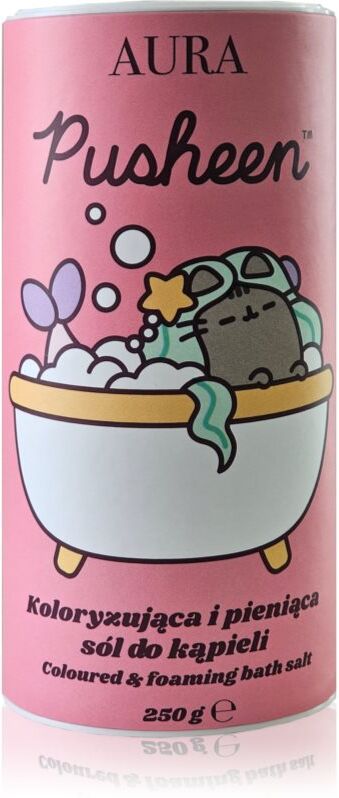
Pusheen Aura bath salts 250 gPusheen Aura, 250 g, Bath Salts for Women, Pusheen Aura bath salts induce well-being and relaxation during your daily bathing routine. Characteristics: moisturises and softens has a pleasant fragrance relaxing effect regenerates the skin How to use: Pour into a warm bath and allow to dissolve.6,00 £*Shipping: 3,99 £Secure redirect to the provider
-
Kneipp Perfect Relaxation bath salts 60 gKneipp Perfect Relaxation, 60 g, Bath Salts for Women, Kneipp Perfect Relaxation bath salts induce well-being and relaxation during your daily bathing routine. Characteristics: relaxing effect How to use: Use water at 36-38°C to prepare the bath. Then remain in the bath for 15-20 minutes.1,30 £*Shipping: 3,99 £Secure redirect to the provider
-
Kneipp Relaxing bath salts Lavender 600 gKneipp Relaxing, 600 g, Bath Salts for Women, Do you love long baths in nice hot water? Your favourite relaxation ritual can be enhanced and taken to another level by Kneipp Relaxing bath salts. It lets you create a fragrant salt bath right in your own home, allowing tension and feelings of inner turmoil to melt away while creating a wonderful sense of well-being. But you don't just get the relaxation you deserve, although the intoxicating smell of salt certainly invites you to do so. Apart from relaxation, your body will also be treated to regeneration. Salt is rich in natural minerals, so it will help with skin regeneration and contribute to relieving any skin issues you may have. Characteristics: strengthens the skin’s defences moisturises and softens regenerates the skin has a pleasant fragrance How to use: Pour into a warm bath and allow to dissolve. All the important and therapeutic ingredients are released in water.7,80 £*Shipping: 3,99 £Secure redirect to the provider
-
What is the structure of salts in chemistry?
In chemistry, salts are composed of positively charged ions (cations) and negatively charged ions (anions) held together by ionic bonds. The cation is usually a metal or a positively charged polyatomic ion, while the anion is typically a nonmetal or a negatively charged polyatomic ion. The structure of salts can vary depending on the specific ions involved, but they generally form a crystalline lattice structure due to the strong electrostatic attraction between the cations and anions. This structure gives salts their characteristic properties, such as high melting and boiling points, and solubility in water. **
-
In what structure are the following salts involved?
The following salts are involved in an ionic structure. Ionic compounds are formed through the transfer of electrons between a metal and a non-metal. This results in the formation of positively charged metal ions and negatively charged non-metal ions, which are held together by strong electrostatic forces of attraction. This structure gives ionic compounds their characteristic high melting and boiling points, as well as their ability to conduct electricity when dissolved in water or melted. **
-
What are the structure and properties of salts?
Salts are ionic compounds composed of positively charged metal ions and negatively charged non-metal ions. They have a crystalline structure with a repeating pattern of ions held together by strong electrostatic forces. Salts are typically solid at room temperature, have high melting and boiling points, and are soluble in water. They can conduct electricity when dissolved in water or melted due to the presence of free ions that can carry an electric current. **
-
Why are salts built up in a crystalline structure?
Salts are built up in a crystalline structure because of the way their molecules arrange themselves when they solidify. The ions in salt compounds are attracted to each other and form a repeating pattern that results in a three-dimensional lattice structure. This regular arrangement allows the ions to maximize their interactions and minimize their energy, leading to the formation of crystals. The specific shape of the crystals is determined by the arrangement of the ions in the lattice structure. **
Similar search terms for Salts
-
Organis Epsom salt bath salts 1000 gOrganis Epsom salt, 1000 g, Bath Products for Men, Organis Epsom salt bath salts induce well-being and relaxation during your daily bathing routine. Characteristics: soothes the body and mind relaxes muscles induces a feeling of well-being and relaxation2,10 £*Shipping: 3,99 £Secure redirect to the provider
-
Organis Epsom salt bath salts 5 kgOrganis Epsom salt, 5 kg, Bath Products for Men, Organis Epsom salt bath salts induce well-being and relaxation during your daily bathing routine. Characteristics: soothes the body and mind relaxes muscles induces a feeling of well-being and relaxation10,20 £*Shipping: 3,99 £Secure redirect to the provider
-
Kneipp For You bath salts gift setKneipp For You, 3x60 g, Bath Salts for Women, Special occasions call for special presents, whether for yourself or your loved ones. The Kneipp For You gift set contains a carefully selected and lovingly curated combination of fragrances and beauty products that are guaranteed to put a smile on the faces of you or your loved ones, whether you dive into exploring them all at once or open them one by one throughout the month. The set contains: I Love You bath salts 60 g My Favourite Person bath salts 60 g Right from the Heart bath salts 60 g Characteristics: amazing as a gift a treat for any woman contains mini versions of products How to use: Pour into a warm bath and allow to dissolve. Use water at 36-38°C to prepare the bath. Then remain in the bath for 15-20 minutes.5,36 £*Shipping: 3,99 £Secure redirect to the provider
-
Kneipp Erkältungzeit Night bath salts 60 gKneipp Erkältungzeit Night, 60 g, Bath Salts for Women, Do you love long baths in nice hot water? Your favourite relaxation ritual can be enhanced and taken to another level by Kneipp Erkältungzeit Nightbath salts. It lets you create a fragrant salt bath right in your own home, allowing tension and feelings of inner turmoil to melt away while creating a wonderful sense of well-being. But you don't just get the relaxation you deserve, although the intoxicating smell of salt certainly invites you to do so. Apart from relaxation, your body will also be treated to regeneration. Salt is rich in natural minerals, so it will help with skin regeneration and contribute to relieving any skin issues you may have. Characteristics: relaxing effect has a pleasant fragrance1,30 £*Shipping: 3,99 £Secure redirect to the provider
-
'Salts or molecules?'
Salts are compounds formed from the reaction of an acid and a base, while molecules are made up of atoms bonded together. Salts are ionic compounds, meaning they are made up of ions, while molecules can be either ionic or covalent compounds. Salts have a specific crystalline structure and are often soluble in water, while molecules can have a wide range of physical properties and solubilities. Overall, salts and molecules are distinct types of chemical compounds with different structures and properties. **
-
Are salts polar?
Yes, salts are polar. Salts are composed of ions, which are charged particles. When salts dissolve in water, the positive and negative ions separate and become surrounded by water molecules, which are polar. This means that salts are able to conduct electricity when dissolved in water, as the charged ions are free to move and carry an electric current. **
-
Which salts are the most hydrophilic, meaning water-attracting salts?
Salts that are composed of ions with high charge density and small size are typically the most hydrophilic, as they have a strong attraction to water molecules. Examples of such salts include sodium chloride (NaCl), potassium chloride (KCl), and calcium chloride (CaCl2). These salts readily dissolve in water due to their strong affinity for water molecules, making them highly hydrophilic. **
-
I am stuck on the tasks about the structure of salts.
Salts are formed when an acid reacts with a base, resulting in the transfer of a proton from the acid to the base. The resulting compound is a salt, which consists of positive and negative ions held together by ionic bonds. The structure of salts can vary depending on the specific ions involved, but they generally form a crystalline structure due to the arrangement of the positive and negative ions in a repeating pattern. Understanding the structure of salts is important in chemistry as it helps to predict their physical and chemical properties. If you are stuck on specific tasks related to the structure of salts, it may be helpful to review the principles of ionic bonding and crystal structures, and to seek additional resources or assistance from a teacher or tutor. **
* All prices are inclusive of VAT and, if applicable, plus shipping costs. The offer information is based on the details provided by the respective shop and is updated through automated processes. Real-time updates do not occur, so deviations can occur in individual cases. ** Note: Parts of this content were created by AI.